How to Hit a Kick Serve
6 video lessons
The spin serve that jumps up high and gives you a reliable second serve.
Quick answer & tips ▾Hide answer ▴
A kick serve uses heavy topspin (with some sidespin) so the ball clears the net with lots of margin, dips into the box and then jumps up high after the bounce. That combination of safety and an awkward bounce is why it is the go-to second serve for most good players.
Use a continental grip, or one turned slightly toward a backhand grip. Toss the ball more above your head than for a flat serve, stay sideways a little longer, and swing up and across the back of the ball, brushing it from low to high rather than hitting through it.
Key tips
- Think "up", not "forward": the racquet should travel up the back of the ball.
- Toss closer to your head rather than out in front.
- Keep your shoulders turned and your head up through contact.
- Aim higher over the net than feels natural; the spin will bring the ball down.
FAQ
- Why is my kick serve not kicking?
- Usually the swing is going forward through the ball instead of up and across it, or the toss is too far in front. Try tossing a little more over your head and finishing with the racquet moving up and out to the side.
- Is a kick serve the same as a topspin serve?
- They are close relatives. A pure topspin serve has mostly forward rotation; a kick serve adds some sidespin, so it jumps up and also kicks sideways after the bounce. Many coaches use the terms loosely.
- Should beginners learn the kick serve?
- Once you have a consistent basic serve with a continental grip, yes. It is harder to learn than a slice serve, but it gives you a safe second serve, which reduces double faults.
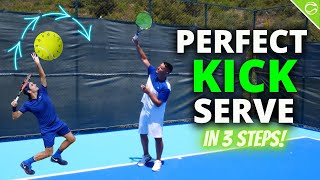
Perfect Kick Serve in 3 Steps - Perfect Tennis (Episode 2)
Top Tennis Training - Pro Tennis Lessons

How to hit a KICK SERVE (tennis lesson)
Essential Tennis - Lessons and Instruction for Passionate Players

How to Hit The Perfect Kick Serve In 7 Steps (WITHOUT Losing Power)
RacquetFlex

How To Hit a Kick Serve in Tennis with Venus Williams
Venus Williams

Tennis KICK SERVE Lesson - Overcoming Second Serve NERVES
Karue Sell

Tennis Serve Pronation Explained For Flat, Slice & Topspin Serves
Feel Tennis Instruction
Related questions

Coming soon
Get your game reviewed by a pro
Send a clip, get a personal breakdown from a coach.
Notify me